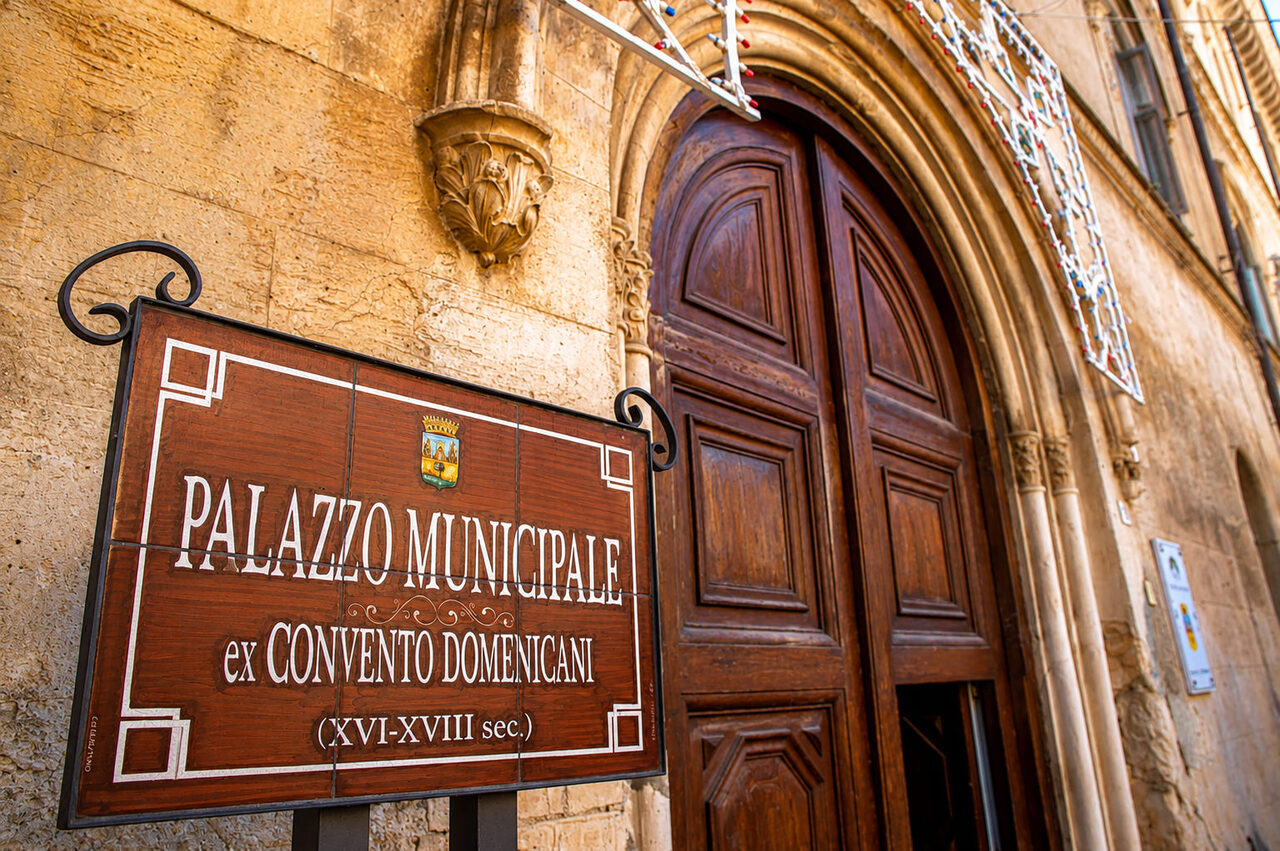
The Municipal Palace is one of the most important civil buildings in Collesano, but it began as a religious complex. It was built around the middle of the 16th century by initiative of Countess Susanna Gonzaga, with support from the town, and served as the Dominican convent until the suppression of religious corporations in 1866.
After the suppression of the convent, the building was restructured as the municipal seat. A second storey had been added in 1769; the present civic appearance belongs to the late-19th-century remodelling.
Inside, the palace preserves paintings on wood and canvas by contemporary artists. The Sala dei Sindaci also keeps works by the local woodcarver Pino Valenti, a reminder that Collesano's public buildings often mix administration, art and local craft.
NoteExterior always visible. Interior depends on opening hours.
Former Dominican convent built around the mid-1500s; second storey added in 1769.
Functioned as a convent until the 1866 suppression of religious corporations, then secularised for municipal use.
Hosts the "Sala dei Sindaci" with works by local woodcarver Pino Valenti and a 17th-century Transfiguration canvas.
In the 17th century Collesano’s wider monastic quarter hosted four religious orders simultaneously: Capuchins, Reformed Conventuals, Dominicans and Benedictines.
From the local historical guide
The building began as the Dominican convent attached to the Annunziata Nuova in the second half of the 16th century; its second storey was added in 1769.
After the 1866 suppression of religious corporations, the complex passed to the town. Giovanni Salemi Pace’s 1880 project created the municipal offices and ground-floor rooms; Luigi Castiglia’s 1906 scheme supplied the later façade decoration, completed in 1907–10.
The second floor contains a gallery of contemporary panel and canvas paintings. The council chamber preserves a 17th-century Transfiguration and an 18th-century leather altar frontal from the Annunziata Vecchia; the building also houses Pino Valenti’s inlaid Sala dei Sindaci and the Targa Florio Museum.
Timeline
1514–1515Susanna Gonzaga marries Pietro II Cardona, Count of Collesano.
mid-1500sA Dominican convent is built on Countess Susanna Gonzaga’s initiative, with the town’s support.
1600sCollesano’s monastic district hosts four orders at once: Capuchins, Reformed Conventuals, Dominicans and Benedictines.
1769A second storey is added to the convent.
1866The suppression of religious orders ends the Dominican use.
1880; 1907–1910Giovanni Salemi Pace’s 1880 project converts the complex for municipal use; façade decoration from Luigi Castiglia’s 1906 restoration design is completed in 1907–1910.
2004The Targa Florio Museum is inaugurated inside the same building.
People & families
Susanna Gonzaga (1485–1556)— Countess of Collesano, daughter of Gianfrancesco Gonzaga of Sabbioneta and Antonia Del Balzo; wife of Pietro II Cardona. Patron of this convent and of the church of San Domenico; the subject of a scholarly biography by Lina Scalisi.
Pietro II Cardona (c.1467–1522)— Count of Collesano, killed at the Battle of Bicocca near Milan in 1522.
Pino Valenti (b. 1947, Collesano)— local wood-inlay (tarsia) artist whose works hang in the Sala dei Sindaci, including a “Table of the Mafia’s Victims” (2001).
Stories & traditions
One building spans five centuries of Collesano power: a Renaissance countess’s convent that became the seat of the comune — and now shelters the Targa Florio Museum.
The council chamber keeps a 17th-century Transfiguration canvas; the Sala dei Sindaci turns local marquetry into civic memory.
In the 1600s the surrounding monastic quarter held four religious orders at once — a measure of how dense Collesano’s church life once was.
Visiting
HoursStandard municipal hours, mornings Mon–Fri
AdmissionPublic building
AccessSteps at the front entrance on Corso Vittorio Emanuele; ask at the municipal entrance for accessible access.