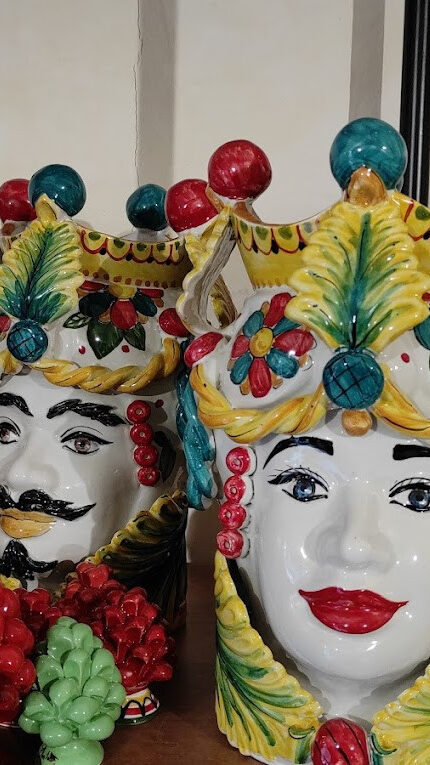
A ceramics workshop run by the Iachetta family across three generations: founded by master Litterio Iachetta — whose pieces are documented as early as 1940 — continued by his son Salvatore (Totò), and today led by his daughter Cinzia, at the helm since 1997. Among the last great families of Collesano's centuries-old ceramic tradition, alongside the Carrà, Barbera, Cellino and Catalano.
The work faithfully follows Madonie shapes and motifs taught by Litterio and Salvatore: candelabra, anthropomorphic oil lamps, 'fiaschi col segreto' (flasks with a hidden trick), basket vases, and the iconic ceramic friars and aubergines. Workshops in both Collesano and Palermo. Walk in to see the artisans at work; pieces can be commissioned and shipped.
Family workshop founded by maestro "Litterio" Iachetta and carried forward through later generations.
Reproduces the classical Madonita repertoire: candelabri, lucerne antropomorfe, frati, fiaschi col segreto, melanzane, vasi a canestro.
Affiliated with Buongiorno Ceramica and the modern six-town Strada Regionale delle Ceramiche Siciliane network.
Ancient pottery is archaeologically attested in the territory; Collesano’s documented workshop and maiolica tradition begins in 1567.
Signature palette: green ramina, straw yellow and manganese, with motifs of floral trophies, heraldic shields, helmets and stylised wolf heads.
Workshops in both Collesano and Palermo (Via Cappuccini 33a).
From the local historical guide
Collesano’s ceramic craft is documented from 1567. Clay came from the Bovitello quarry, recorded from 1585, and was worked, fired and glazed in workshops called stazzuna, which eventually clustered on the town’s eastern edge and gave the Stazzone quarter its name.
The last traditional kiln, dating from the early 20th century, preserves the wheel, the half-moon mill used to prepare metallic oxides for glazing, and the wood-fired combustion chambers.
Until the mid-19th century production ranged from roof tiles, bricks, pipes and floor tiles to zoomorphic salt cellars, inkwells and containers for aromatic plants. Later workshops turned toward popular domestic majolica — flasks, bottles, jugs and anthropomorphic lamps — in copper green, straw yellow and manganese.
Important examples are held by Palazzo Abatellis and the Pitrè Museum in Palermo and the International Museum of Ceramics in Faenza. Today local workshops continue the tradition through both historic forms and new designs.
Timeline
7th c. BCAncient pottery is archaeologically attested at Monte d’Oro; this is territorial background, not the start of the documented Collesano workshop tradition.
1567The earliest document attesting ceramic workshops (stazzoni) in Collesano — kiln remains survive near Borgo Stazzone.
1585A contract records clay extraction from the Bovitello quarry — the prized dark “nigra” clay.
1600sA golden age of refined “trophy” maiolica: heraldic shields, helmets and stylised wolf-heads.
1769A dated devotional tile panel survives.
late 1700sCollesano-trained masters (the REIS registry names Savia and Rizzuto) are credited with spreading the craft to other Sicilian ceramic centres.
1940The earliest documented pieces by master Litterio Iachetta.
1997Cinzia Iachetta takes over the family workshop.
2022Collesano joins the new “Strada Regionale delle Ceramiche Siciliane” as one of six member towns.
People & families
Litterio Iachetta— master whose pieces are documented from 1940; gave new lustre to Collesano ware.
Salvatore “Totò” Iachetta— his son, one of the last master ceramists of the town.
Cinzia Iachetta— third generation, running the workshop since 1997.
The old dynasties— Carrà, Barbera, Cellino, Catalano, Cirri and Asciutto, the families who carried Collesano’s craft across the centuries.
Stories & traditions
Collesano is one of the “six sisters” of Sicilian ceramics, alongside Caltagirone, Santo Stefano di Camastra, Sciacca, Burgio and Monreale.
The repertoire runs to anthropomorphic oil-lamps shaped as fashionable ladies, trick flasks (“fiaschi col segreto”), ceramic friars, aubergines and basket vases.
That wolf’s head on the old apothecary jars is a decorative motif of the “trophy” style — not the town’s coat of arms, whose colours are the blue and gold of the Ventimiglia.
The whole tradition is catalogued in T. Gambaro’s book “La ceramica di Collesano dal XVII secolo a oggi” (2000).