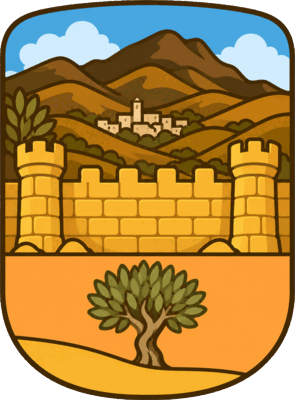
The ruins of Collesano Castle mark the northern edge of the town and the older fortified history behind the present village. The Norman settlement itself took shape around 1130–1140, when Roger II moved the population from Monte d'Oro to the Bagherino hill. A 1194 document calls the new town an oppidum — a fortified, walled centre.
The castle's exact foundation date is unknown. Its first clear documentary reference dates to 1308–1310, so the local guide assigns the surviving complex at least to the 13th century while allowing for earlier structures. It has a quadrangular plan with a large inner court and four corner towers.
In later centuries the castle passed through major Sicilian families, including the Cicala, De Monfort, Ventimiglia, Cardona and Moncada. Under the Ventimiglia, Collesano became an important county center; under the Moncada, the castle reached one of its richest phases, even hosting theatrical performances by the local Accademia degli Offuscati.
Adapted as a residential palace in the late 16th century, the castle was badly damaged by the earthquake of 1693. It remained the town prison until another earthquake made it unusable in 1819. Today only ruins remain, especially the north-east tower near the entrance, but the site still gives one of the clearest views of Collesano's medieval power.
The Norman town was established on the Bagherino hill around 1130–1140; the castle’s exact foundation date is unknown.
A 1194 document calls the town an oppidum, while the first clear documentary reference to the castle dates to 1308–10.
Held in succession by Adelasia of Adernò, the Cicala, the Ventimiglia, the Cardona (1444–1537), the Moncada, and the Alvarez de Toledo / Dukes of Ferrandina (until 1813).
Adapted as a residential palace in the late 16th century, then badly damaged by the 1693 earthquake; used as the town prison until another earthquake made it unusable in 1819.
Quadrangular plan with a large inner court and four corner towers; only the north-east tower remains partly intact.
Recently acquired by the municipality and partially consolidated in preparation for a broader restoration.
From the local historical guide
The Norman town of Collesano was founded around 1130–40 after Roger II moved the settlement from Monte d’Oro to the Bagherino hill. A 1194 document calls the new town an oppidum — a fortified, walled centre.
The castle itself has a quadrangular plan with a large courtyard and four corner towers; only the north-east tower remains partly intact. Its exact foundation date is unknown: the first clear documentary reference dates to 1308–10, so the guide places the surviving complex at least in the 13th century while allowing for earlier structures.
Converted into a residential palace at the end of the 16th century, the castle was badly damaged by the earthquake of 11 January 1693. It remained the town prison until another earthquake made it unusable in 1819.
Across the centuries it belonged to the Ventimiglia, Centelles, Aragona, Cardona and Moncada counts. The municipality has recently acquired it and consolidated parts of the masonry in preparation for a broader restoration.
Timeline
c.1130–1140Roger II moves the settlement off Monte d’Oro; the Norman borough of “Golisano” takes shape on the Bagherino hill.
1194A document describes the settlement as an oppidum — a fortified, walled centre.
1202Infeudated to Paolo Cicala, who takes the title of count.
1305Held by Francesco I Ventimiglia and annexed to the great County of Geraci.
1308–1310The first clear documentary reference to the castle; its surviving fabric is assigned at least to the 13th century, while earlier structures remain possible.
1354The Ventimiglia are (re)invested in the County of Collesano — Francesco II Ventimiglia is recognised as count (the comital title itself dates back to Paolo Cicala in 1202).
1398The county is confiscated from the Ventimiglia by King Martin I.
1444Alfonso the Magnanimous grants the county to the Cardona family.
1537It passes to Antonia Cardona and, by her marriage, to the Aragona (Dukes of Montalto).
1584–85María de Aragón marries Antonio Moncada, Prince of Paternò — the county passes to the Moncada.
1600sA great hall is turned into a theatre by the Accademia degli Offuscati.
1693The Val di Noto earthquake badly damages the castle, which later continues in use as the town prison.
c.1713It passes to the Álvarez de Toledo, Dukes of Ferrandina (their formal investiture in the county is dated 1752 by other sources).
until 1819The ruins serve as the town prison; feudalism is abolished in 1812–13.
People & families
Roger II & domina Adelicia— Roger II founded the settlement of Golisano; the local guide then names his niece Adelicia as a feudatory of Collesano, not as the castle’s founder.
The Ventimiglia— counts who held Collesano within their great Madonie state; they were (re)invested with the county in 1354.
The Cardona (1444–1537)— Catalan house granted the county by Alfonso the Magnanimous; Pietro II Cardona is the best-known count.
The Moncada, Princes of Paternò— acquired Collesano by the 1584 marriage of María de Aragón; under them the castle theatre flourished.
The Álvarez de Toledo— Dukes of Ferrandina, last feudal holders until the abolition of feudalism (1812–13).
Stories & traditions
The town’s very name began here: Roger II’s new borough of “Golisano” gave, over the centuries, “Collesano”.
In its richest years the castle was not only a fortress but a stage — the Accademia degli Offuscati performed plays in its great hall.
Six great houses held it in turn — Cicala, Ventimiglia, Cardona, Aragona, Moncada and finally Álvarez de Toledo — a roll-call of medieval and early-modern Sicilian power.
Today little stands but the north-east tower and stretches of wall, yet the site still gives the clearest view of the county’s medieval power.
Visiting
HoursSite is unsafe — only ruins remain; exterior visible from path
AdmissionFree (exterior only)
AccessRough, uphill trail; not accessible to wheelchairs or strollers.