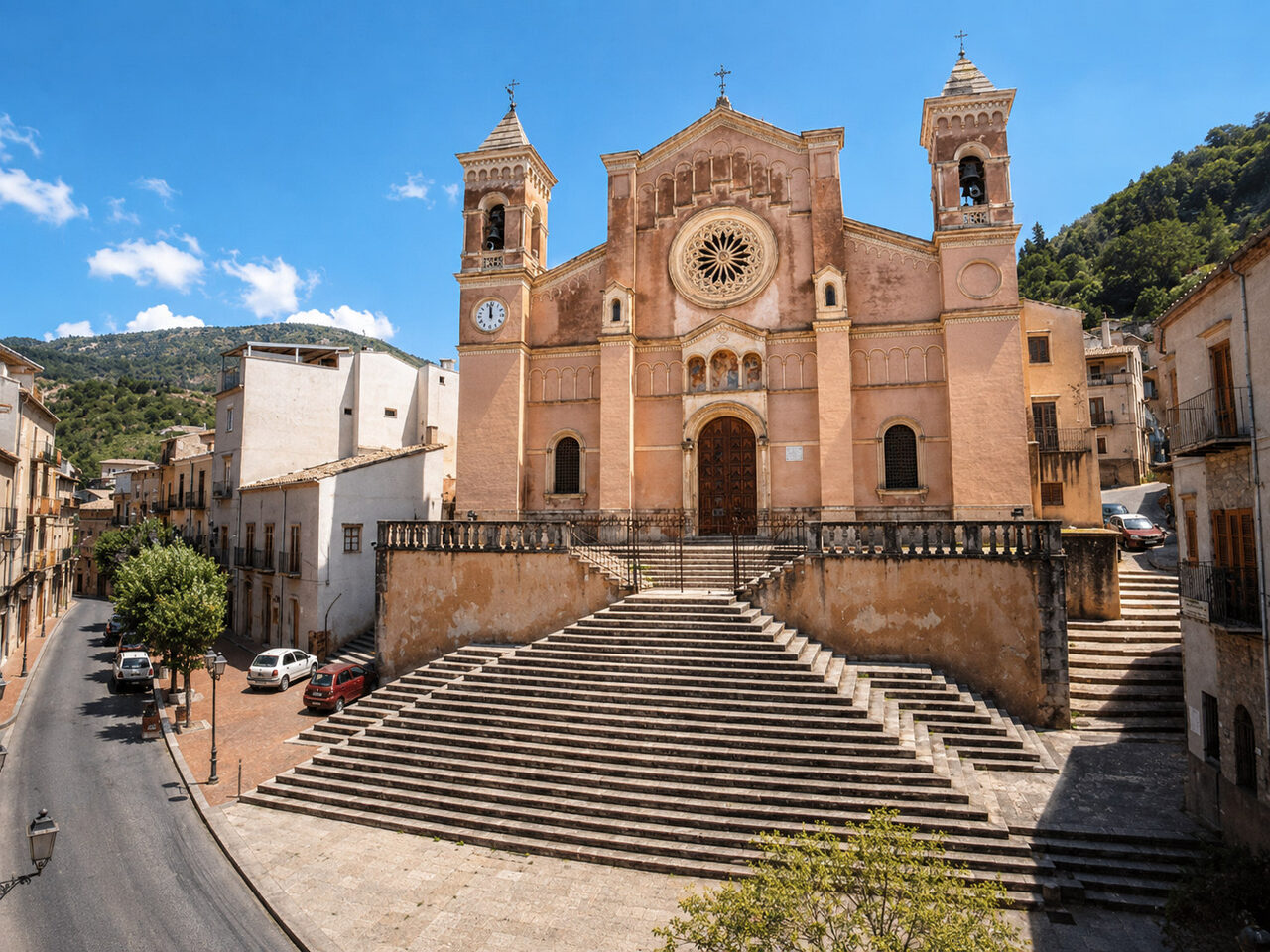
The Mother Church, or Basilica of Saints Peter and Paul, dominates Collesano from the top of its monumental staircase. Begun around the turn of the 16th century, it became the Mother Church in 1543 and was consecrated in 1548. The present neo-Romanesque façade dates to 1900.
Inside, the basilica has three naves and a dense collection of art from other churches of Collesano. The presbytery walls preserve the 1624 fresco cycle with stories of Saints Peter and Paul by Gaspare Vazzano, known as Lo Zoppo di Gangi.
Look up in the central nave for the mid-16th-century suspended Crucifix; Antonello Sillaro’s Resurrection on its reverse is dated 1555. Other highlights include Antonino La Valle’s 1627 organ in an older gilded wooden case, Andrea Russo’s choir carved in 1570–1585, the 1489 marble tabernacle from Santa Maria Assunta, and the Madonna dei Miracoli, patroness of Collesano.
NoteExterior always visible. Interior depends on opening hours.
Begun around the turn of the 16th century, Mother Church from 1543 and consecrated in 1548; neo-Romanesque façade completed in 1900.
Elevated to Minor Basilica by Pope John Paul II in 1983.
Fresco cycle by Gaspare Vazzano "Zoppo di Gangi" (1624): 22 ovals and 13 panels on the lives of Saints Peter and Paul.
Marble tabernacle dated 1489, brought from Santa Maria Assunta and commissioned by presbyter Francesco Sunzerio.
Houses the "Maria Santissima dei Miracoli" — a 15th-century painting venerated as patroness of Collesano since 1641.
Holy Week processions and patronal feast 25–27 May (procession on the 26th).
From the local historical guide
San Pietro began to rise in the early 16th century and was consecrated in 1548. Major 17th-century transformations added the staircase, carved balustrade and richly decorated chapels; the neo-Romanesque façade dates from 1900, and the church became a minor basilica in 1983.
Among its central works are the suspended mid-16th-century Crucifix, painted on the reverse with Antonello Sillaro’s Resurrection of 1555; Antonino La Valle’s organ of 1627; and Gaspare Bazzano’s cycles of Saints Peter and Paul and the life of Christ, completed by 1624.
The walnut choir was carved by Andrea Russo between 1570 and 1585, while Francesco Testagrossa made the embossed-silver altar frontal in 1721. The imposing marble tabernacle, dated 1489 and commissioned by vicar Francesco Sunzeri, came from Santa Maria Assunta.
Santa Maria Assunta still stands in Piazza Castello. Attested from 1140 under the title San Pietro, it served as Collesano’s Mother Church until 1543 and preserves works including Antonello Gagini’s marble Madonna and Child of about 1516.
Timeline
1140The earlier Mother Church, Santa Maria la Vecchia (Assunta), is founded; it remains the matrice until 1543.
late 15th c.San Pietro is begun on the hilltop.
1489A marble tabernacle is commissioned by presbyter Francesco Sunzerio from the Gagini workshop.
1543Completed under Pope Paul III; San Pietro becomes the new Mother Church.
1548Consecrated by Mariano Manno, a bishop from Sciacca.
1555Antonello Sillaro dates the Resurrection on the reverse of the mid-16th-century suspended Crucifix to 1555.
1570–1585Andrea Russo carves the wooden choir.
1602Antonino Spatafora designs the monumental staircase.
1619Giuseppe Li Volsi makes the Sacrament-chapel stuccoes.
1624Gaspare Vazzano “Zoppo di Gangi” frescoes the presbytery — 22 ovals and 13 panels on the lives of Peter and Paul.
1627Antonino La Valle makes the organ; its gilded and painted wooden case is older, approximately mid-16th century.
1641The Madonna dei Miracoli is proclaimed patroness of Collesano (a miracle of 26 May 1643 is later attached to the feast).
1983Pope John Paul II elevates the church to a Minor Basilica.
People & families
Domenico Gagini (c.1420–1492)— founder of the Gagini dynasty of sculptors; his workshop (with Giorgio da Milano and Andrea Mancino) carved the 1489 marble tabernacle.
Antonino Spatafora— painter-engineer who designed the church’s monumental staircase in 1602.
Gaspare Vazzano “Zoppo di Gangi” (1562–1630)— painter of the 1624 presbytery fresco cycle.
Andrea Russo— Collesano woodcarver of the 1570–1585 choir.
Antonino La Valle— master who made the organ in 1627; its gilded and painted wooden case is older. Giuseppe Li Volsi made the 1619 stuccoes.
Francesco Sunzerio— presbyter who funded the 1489 tabernacle; the 1624 frescoes were paid for from townspeople’s alms gathered by the priest Paolo Brocato.
Stories & traditions
Look up in the nave: the mid-16th-century Crucifix hangs from a wooden machine; Antonello Sillaro’s Resurrection on the reverse is dated 1555, so the cross “turns” from death to life.
The town’s patroness, the 15th-century painting of the Madonna dei Miracoli, is carried through the centro storico each year at the feast of 25–27 May.
The “Zoppo di Gangi” (the Limper of Gangi) was long thought a single painter; archival study revealed two — Gaspare Vazzano and his pupil Giuseppe Salerno — both nicknamed for a limp.
The basilica gathers art from across Collesano’s churches — including a marble Apostle predella attributed to Antonello Gagini, Domenico’s son.
Visiting
HoursOpen mornings and for late-afternoon Mass
AdmissionFree
AccessThe Spatafora staircase is the main barrier for wheelchair users; ask the parish about a side entrance.