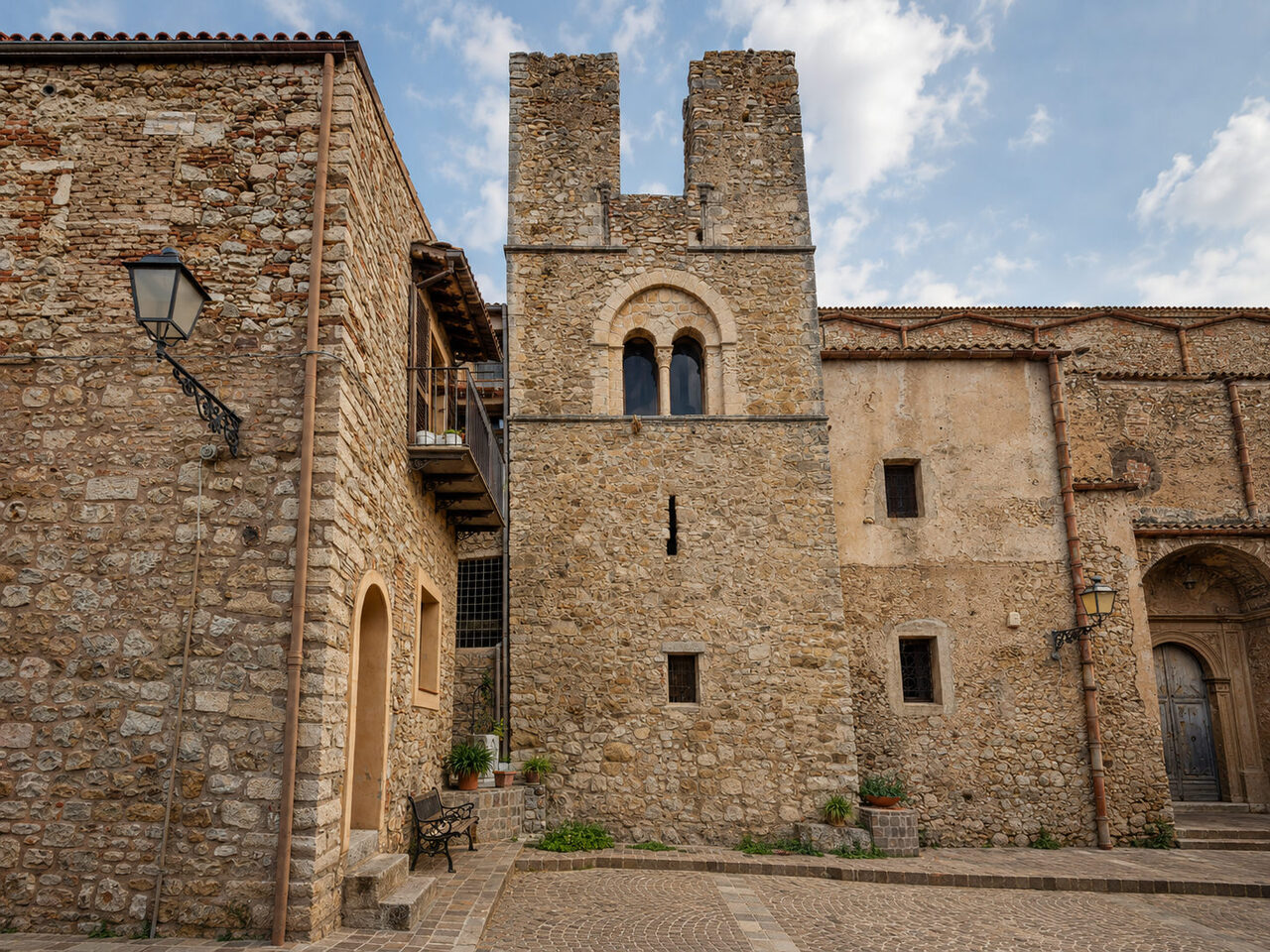
The Watchtower stands beside the Mother Church in Piazza Plebiscito, traditionally called Piazza della Misericordia. The local guide dates this originally isolated medieval structure to between the 13th and 14th centuries.
Absorbed into the Mother Church during its construction in the early 16th century, the tower served as its bell tower until the early 20th century.
It has a square plan and rises through four levels. The third is distinguished by an elegant carved-stone mullioned window resting on a small column with a crochet-decorated capital. The surrounding square takes its traditional name from the 16th-century Misericordia church and its former hospital, founded in 1539.
Probably built between the 13th and 14th centuries, originally as an isolated lookout.
Square plan, four levels; the third has a carved-stone bifora with a crochet-decorated capital.
Annexed to the Mother Church when the latter was built; served as its bell tower until the early 1900s.
Stands in Piazza Plebiscito, one of the panoramic balconies over the Madonie valleys.
From the local historical guide
Officially Piazza Plebiscito, this space is still known as Piazza della Misericordia after the 16th-century church whose confraternity ran an adjoining hospital founded in 1539 and active until 1813.
The medieval watchtower was probably raised as a freestanding structure between the 13th and 14th centuries. Absorbed into the Mother Church in the early 16th century, it served as its bell tower until the early 20th century; the third of its four levels has an elegant carved-stone mullioned window.
Nearby Palazzo Fatta Del Bosco was built by the noble family during the 18th century. Its three-storey Baroque façade retains carved-stone balconies with “goose-breast” iron railings and an attached private chapel.
Opposite the palace, a locally made ceramic panel of the Immaculate Conception dated 1769 survives as popular devotional art linked to the lost church of Santa Maria dello Stellario.
Timeline
10th–11th c.Arab geographers cite the site as Qal‘at as-sirat, “the fortress of the road”.
c.1140Roger II destroys the older Monte d’Oro stronghold (Qal‘at as-sirat) and moves the settlement down to the present town site — its first nucleus the Bagherino quarter.
13th–14th c.The square, four-level watchtower probably rises as an isolated lookout; the third level retains its carved-stone bifora.
16th c.The new Mother Church absorbs the tower into its flank and uses it as a bell tower.
until 1912The tower serves as the Mother Church’s campanile.
Stories & traditions
For its first centuries the tower stood alone, a sentinel watching the road while the village grew below around the castle.
A slender two-light window (bifora) with a crocket capital survives on the upper floor — its 14th-century style leaves the tower’s exact phase (Norman, Swabian or Aragonese) unsettled.
The square it crowns, the Piano della Misericordia, is named for a small Church of the Misericordia and looks out between the Madonie peaks and the Tyrrhenian Sea.
Visiting
HoursExterior visible at all times; interior not regularly open
AdmissionFree (exterior)
AccessReached via uphill historic-centre lanes — paved but steep; not stroller- or wheelchair-friendly from below.