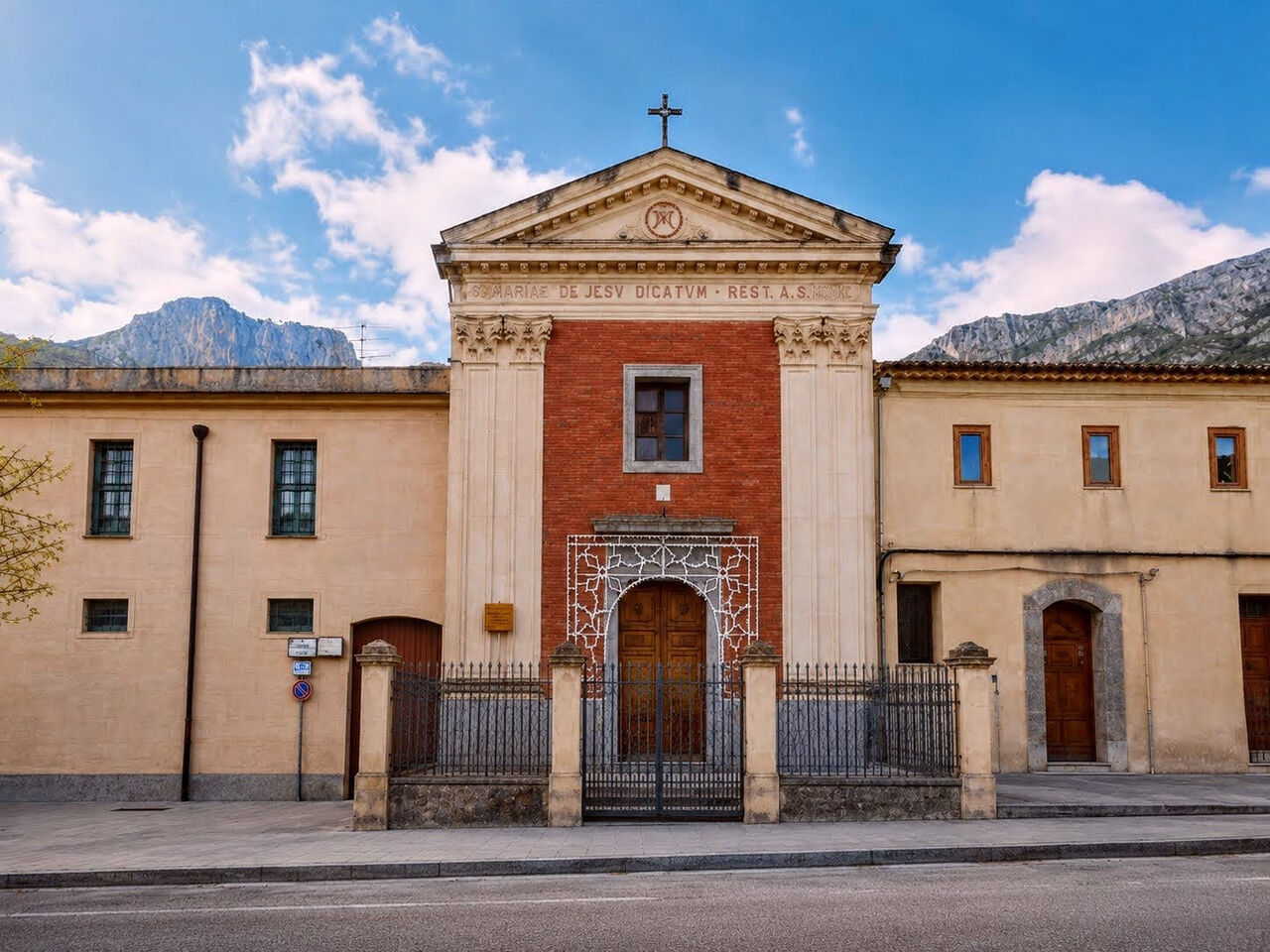
The Church and Convent of Santa Maria di Gesù is one of Collesano's quieter Franciscan landmarks: simple from the street, but rich in local memory. A local historical guide dates the foundation to 1612 and attributes it to the Universitas of Collesano and Countess Maria Aragona, wife of Count Francesco Moncada. Pope Paul V blessed the first stone in Rome; it was brought to Collesano and placed in the convent facade on 3 February that year.
The church was entrusted to the Reformed Friars Minor and kept a deliberately simple plan: one nave, a vaulted ceiling, a high altar and six side altars. Look especially for the Porziuncola painting on the high altar, commissioned in 1625 by the Micciancio family and signed by Gaspare Buzzata, and for the marble Madonna with Child by Carlo D'Aprile.
The most venerated work is the wooden Crucifix of 1635 by fra Umile Pintorno da Petralia Soprana. Its blessing on 11 February 1635 was treated as a major civic event: the Crucifix was first taken to the Mother Church, then carried in procession to Santa Maria di Gesù and placed in a chapel near the high altar, decorated with paintings by G. G. Lo Varchi. Devotion became so strong that the Crucifix was proclaimed co-patron of the town. The fragile original was retired from processions in 1919; Luigi Maniscalco’s 1957 replica is carried during the feast of 13–14 September.
The former convent beside the church later served different civic uses after the suppression of religious orders, including barracks and prison. Today it houses the municipal library and cultural spaces. Its 17th-century cloister rests on 12 stone columns; the capitals show the coats of arms of the Collesano families who paid for them. Also notable inside the church is the carved wooden tabernacle-case dated 1763, with small columns, mother-of-pearl inlay, a small Crucifix and five finely carved figures.
NoteExterior always visible. Interior depends on opening hours.
Founded in 1612 by the Universitas of Collesano; tradition also associates Maria d’Aragona and Francesco Moncada, perhaps through a bequest.
Houses the celebrated wooden Crucifix carved in 1635 by Fra Umile da Petralia — said to show three different expressions (smiling, agonising, dead) depending on the viewing angle.
Marble Madonna with Child by Carlo D'Aprile, one of the leading 17th-century Sicilian sculptors.
Father Rosario Barbera built a new convent on the church’s right side in 1887; the older suppressed complex served as a prison and law court before becoming the library and historical archive.
From the local historical guide
The local guide dates the foundation of the church, convent and cloister to 1612, by the Universitas of Collesano and Countess Maria Aragona. Pope Paul V blessed the first stone in Rome before it was set into the façade on 3 February.
The Collesano priest Giuseppe Micciancio supervised the building work. He and his mother Eleonora appear in the large Porziuncola altarpiece, painted in 1625 by Gaspare Buzzatta of Piazza Armerina.
Inside the single-nave church, the guide highlights Fra Umile da Petralia’s wooden Crucifix of 1635, a 1621 painting attributed to Vincenzo La Barbera, Carlo Aprile’s marble Madonna and Child dated 1664, and the carved, mother-of-pearl-inlaid tabernacle of 1763.
The old convent was taken over by the state under the 1866–67 suppression laws, later serving as a prison and courthouse. Restored in 2005, it now houses the civic library and municipal historical archive; the cloister’s twelve stone columns bear the arms of the families who funded them.
Timeline
1612The Universitas of Collesano founds the church and convent of the Reformed Friars Minor; local tradition also associates Maria d’Aragona and Francesco Moncada, perhaps through a bequest.
3 Feb 1612The first stone, blessed in Rome by Pope Paul V, is set into the convent façade.
1625–26The Porziuncola altarpiece is painted by Gaspare Buzzata for the Micciancio family.
1635Fra Umile da Petralia carves the venerated wooden Crucifix; the cross supporting it is the work of Innocenzo da Petralia.
17th c.The Crucifix becomes so venerated it is proclaimed co-patron of Collesano; carried in procession in September.
1763The carved wooden tabernacle-case with mother-of-pearl inlay is made.
after 1866Religious orders are suppressed; the convent is turned into barracks, then a prison.
1887A new convent is built by Father Rosario Barbera.
1919The fragile original Crucifix is retired from the processions.
1957A replica by sculptor Luigi Maniscalco (finished 12 April) is carried in the modern 13–14 September feast.
People & families
The Aragona–Moncada counts— Collesano was held in the early 1600s by Antonio d’Aragona Moncada; local tradition credits the foundation to the patron-couple Francesco II Moncada and Maria d’Aragona, though both had died before 1611 (so it likely reflects a bequest or pious memory).
Fra Umile da Petralia (1600–1639)— born Giovan Francesco Pintorno at Petralia Soprana; a Reformed Franciscan lay brother and the most celebrated Sicilian carver of polychrome wooden crucifixes.
Innocenzo da Petralia (1591–1648)— friar-sculptor of Petralia Sottana who carved the cross that bears Fra Umile’s figure here.
Carlo D’Aprile (Genoa 1621 – Palermo 1668)— sculptor of the Sicilian Baroque (Carona family); the church’s marble Madonna with Child is his.
Giovan Giacomo Lo Varchi (Collesano 1606–1683)— local painter, follower of Gaspare Bazzano, who decorated the Crucifix chapel.
Father Rosario Barbera— built a new convent on the right side of the church in 1887, separate from the older suppressed complex.
Stories & traditions
A Franciscan legend says angels finished Fra Umile’s crucifixes at night, and that he vowed to carve thirty-three — one for each year of Christ’s life.
A local tale holds that the Crucifix’s face seems to change — smiling, suffering, dead — with the viewing angle; it is repeated in town but not found in older sources.
The September feast falls on the Exaltation of the Cross; since the original was retired in 1919, Maniscalco’s 1957 replica is the one carried through the streets.
The 17th-century cloister rests on twelve stone columns paid for by local devotees; their coats of arms appear on the capitals.
After the orders were suppressed, the old complex served as a prison and law court before becoming today’s municipal library and historical archive.
Visiting
HoursMornings; for Mass and on request
AdmissionFree
AccessStepped entrance from Via Polizzi; single nave is level inside.